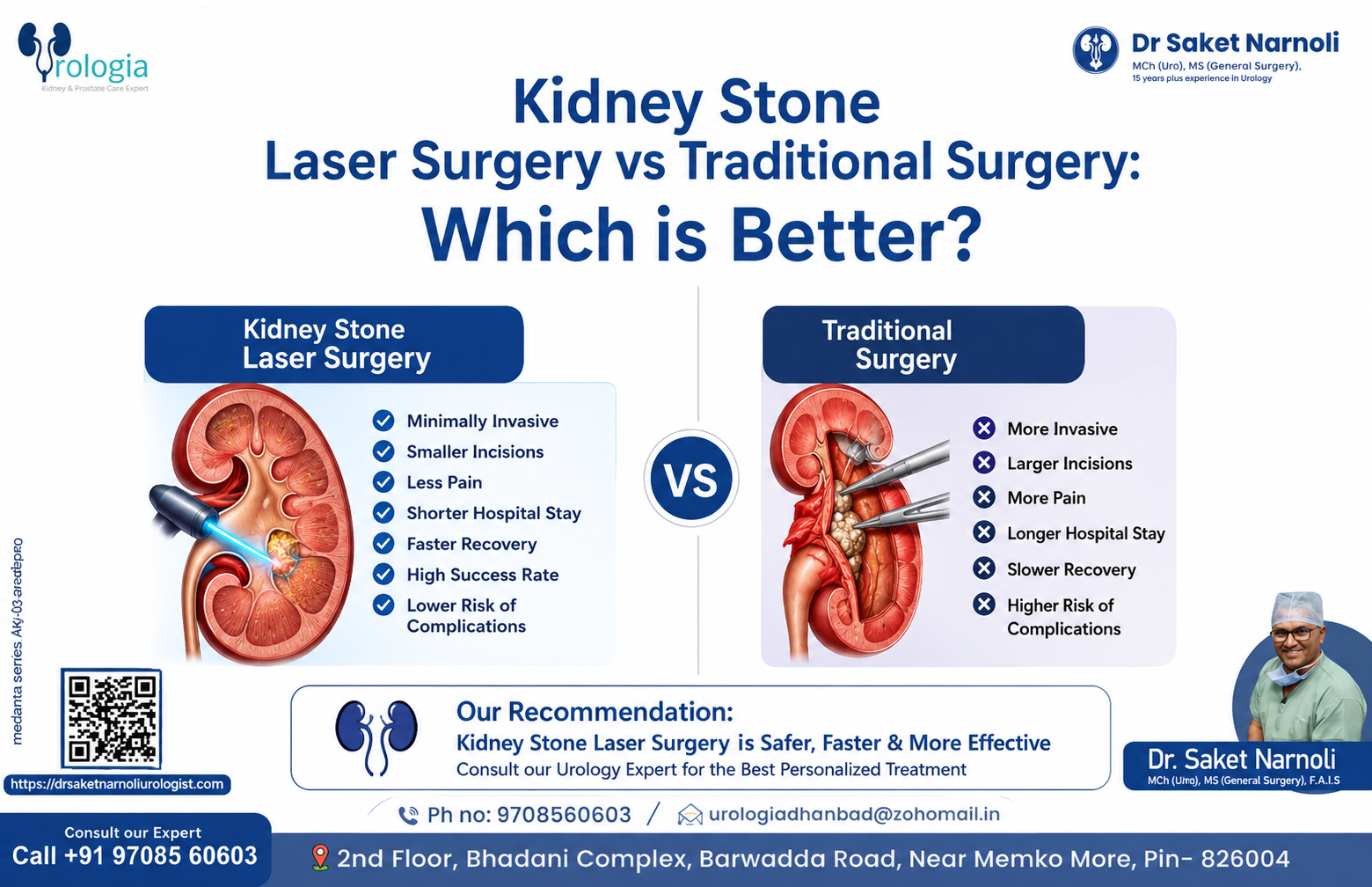
Kidney stones affect millions of people worldwide, causing severe pain and requiring medical intervention. When it comes to treatment, patients face a critical decision: Kidney Stone Laser Surgery or Traditional Surgery? This comprehensive guide compares both approaches, helping you make an informed decision about your kidney stone treatment.
If you’re searching for the best Uro-oncologist doctor Dhanbad or laser kidney stone treatment options, you’re in the right place. Modern medicine has revolutionized kidney stone removal, with Laser Kidney Stone Surgery emerging as the preferred choice for most patients.
What is Kidney Stone Laser Surgery?
Kidney Stone Laser Surgery (also known as laser lithotripsy) is a minimally invasive procedure that uses high-energy laser pulses to break kidney stones into tiny fragments that can be easily passed through the urinary tract.
How Laser Kidney Stone Treatment Works
- Procedure Access: A small lighted instrument (ureteroscope) is inserted through the urethra and bladder to reach the kidney or ureter
- Laser Fragmentation: A laser fiber transmits Holmium energy to break the stone into small pieces
- Stone Removal: Larger fragments are removed through the urethra; smaller pieces pass naturally during urination
- Duration: The surgery typically takes under 1 hour, depending on stone size and number
Key Features of Laser Kidney Stone Surgery
- No external incisions required
- Performed under general anesthesia
- Minimally invasive approach
- High precision and control
What is Traditional Surgery for Kidney Stones?
Traditional Surgery refers to open surgical procedures or larger incision-based approaches used to remove kidney stones. This includes:
- Open Nephrolithotomy: Large incision in the back or flank
- Percutaneous Nephrolithotomy (PCNL): Small incision with tube insertion (still more invasive than laser)
- Open Ureterolithotomy: Incision to access ureter stones
Traditional methods were the standard before minimally invasive techniques became widely available
Comparison: Laser vs Traditional Surgery
| Factor | Kidney Stone Laser Surgery | Traditional Surgery |
|---|---|---|
| Invasiveness | Minimally invasive, no external cuts | Large incisions required |
| Pain Level | Reduced pain and discomfort | Significant post-operative pain |
| Recovery Time | Few days to 1 week | 2–6 weeks for full recovery |
| Hospital Stay | 1-day stay or day procedure | 3–7 days hospitalization |
| Scarring | Minimal to no visible scars | Large, visible scars |
| Success Rate | 70–99% depending on stone size | High but with more complications |
| Complication Risk | Lower risk of infection, bleeding | Higher risk of complications |
| Blood Loss | Minimal blood loss | Significant blood loss possible |
| Return to Work | 3–7 days | 2–4 weeks |
| Procedure Time | Under 1 hour | 2–4 hours |
Key Benefits of Kidney Stone Laser Surgery
1. Minimally Invasive Approach
Laser kidney stone treatment involves only small internal access points with no large cuts in the body, significantly reducing tissue trauma.
2. High Success Rate
Laser Kidney Stone Surgery achieves success rates ranging from 70% to 99%, depending on stone size and location. Up to 90% of stones are completely removed in a single procedure.
3. Faster Recovery Time
Patients typically return to normal activities within a few days to a week after laser surgery, compared to weeks with traditional methods.
4. Reduced Pain and Discomfort
Since laser lithotripsy doesn’t involve large incisions or tissue trauma, patients experience significantly less post-operative pain.
5. Lower Complication Risk
The risk of infection, bleeding, and damage to surrounding organs is substantially lower with laser kidney stone treatment.
6. Effective for All Stone Types
Laser lithotripsy can treat all types of kidney stones, including large stones that cannot be passed naturally.
7. Precise and Controlled
Newer lasers are precise and powerful, making it easier for surgeons to control and fragment stones, reducing surgery time.
Recovery: Laser Surgery vs Traditional Surgery
Kidney Stone Laser Surgery Recovery:
- Hospital Stay: 1 day or same-day discharge
- Pain Medication: Needed for 2-3 days only
- Normal Activities: Return in 3-7 days
- Work: Resume in 3-5 days for desk jobs
- Heavy Lifting: Avoid for 1 week
- Full Recovery: 1-2 weeks
Traditional Surgery Recovery:
- Hospital Stay: 3-7 days
- Pain Medication: Needed for 2-3 weeks
- Normal Activities: Return in 2-4 weeks
- Work: Resume in 2-4 weeks
- Heavy Lifting: Avoid for 6-8 weeks
- Full Recovery: 6-8 weeks
Common Myths About Kidney Stone Laser Surgery
Myth 1: “Laser surgery doesn’t work for large stones”
Fact: Advanced laser techniques like RIRS can effectively treat large stones up to 2-3 cm.
Myth 2: “Laser surgery has lower success rates”
Fact: Success rates range from 70-99%, with up to 90% complete stone removal in one procedure.
Myth 3: “Traditional surgery is more thorough”
Fact: Laser lithotripsy is equally effective with fewer complications and faster recovery.
Myth 4: “Laser surgery is too expensive”
Fact: When considering reduced hospital stay and faster return to work, overall costs are comparable or lower.
Myth 5: “You’ll need multiple laser sessions”
Fact: Most patients achieve complete stone removal in a single procedure.
Prevention Tips After Kidney Stone Surgery
Regardless of treatment method, preventing recurrence is essential:
Dietary Changes:
- Drink 2.5-3 litters of water daily
- Reduce sodium intake (<2,300 mg/day)
- Limit animal protein (meat, eggs, fish)
- Consume adequate calcium (1,000-1,200 mg/day)
- Reduce oxalate-rich foods (spinach, nuts, chocolate)
Lifestyle Modifications:
- Maintain healthy body weight
- Exercise regularly
- Avoid excessive vitamin C supplements
- Limit sugary beverages
Medical Management:
- Regular follow-ups with your best Uro-oncologist doctor Dhanbad
- 24-hour urine testing to identify metabolic abnormalities
- Medications if prescribed (thiazides, citrate, allopurinol)
Conclusion
Kidney Stone Laser Surgery is the better choice for most patients compared to traditional surgery. It offers a minimally invasive approach with no external cuts, significantly less pain, faster recovery (3-7 days vs. 2-6 weeks), and lower complication rates. With success rates of 70-99%, same-day discharge, and the ability to treat all stone types, laser kidney stone treatment has become the gold standard. While traditional surgery may still be needed for rare complex cases, laser surgery is clearly superior for the vast majority. If you’re in Dhanbad, consult the best Uro-oncologist Surgeon Dhanbad like Dr. Saket Narnoli for expert Kidney Stone Laser Surgery Dhanbad and advanced minimally invasive care.
Book Your Appointment Today
Get expert urology care at Dhanbad Urologist. Click here to schedule your consultation now.
FAQs – Kidney Stone Laser Surgery vs Traditional Surgery
1. Is Kidney Stone Laser Surgery better than Traditional Surgery?
Yes, for most patients, laser surgery offers less pain, faster recovery, and fewer complications than traditional surgery.
2. How long does it take to recover from Kidney Stone Laser Surgery?
Most patients can return to normal activities within 3–7 days and achieve full recovery within 1–2 weeks.
3. Is Kidney Stone Laser Surgery painful?
The procedure is performed under anesthesia, and post-operative discomfort is usually mild compared to traditional surgery.
4. Can laser surgery remove large kidney stones?
Yes, advanced laser techniques can effectively treat many large kidney stones, depending on their size and location.
5. How successful is Laser Kidney Stone Surgery?
Laser kidney stone treatment has a success rate of approximately 70–99%, depending on the stone characteristics.
6. Will I need to stay in the hospital after laser surgery?
Most patients are discharged the same day or within 24 hours after the procedure.