
A urethral stricture is a narrowing of the urethra caused by scar tissue. Because the urethra carries urine from the bladder out of the body, narrowing can make it difficult for urine to pass normally.
Men may notice a weak urine stream, difficulty starting urination, spraying of urine, incomplete bladder emptying, or repeated urinary infections. These symptoms can sometimes be mistaken for an enlarged prostate or a urinary infection, which is why proper urological evaluation is important.
If you are experiencing persistent difficulty passing urine, understanding the possible causes and treatment options can help you seek appropriate care at the right time.
What Is a Urethral Stricture?
A urethral stricture develops when scar tissue narrows part of the urethra.
Normally, urine can pass freely through the urethra. When a stricture develops, the opening becomes narrower and urine flow may become restricted.
Depending on its location and severity, a stricture can cause anything from mild changes in urine flow to significant difficulty emptying the bladder.
Urethral stricture is much more common in men than women.
What Are the Symptoms of Urethral Stricture?
The symptoms can vary depending on how narrow the urethra has become.
Common symptoms include:
- Weak or slow urine stream
- Difficulty starting urination
- Straining to pass urine
- Spraying or splitting of the urine stream
- Feeling that the bladder has not emptied completely
- Pain or discomfort while urinating
- Passing urine more frequently
- Urinary urgency
- Recurrent urinary tract infections
- Dribbling after urination
- In severe cases, inability to pass urine
The American Urological Association recommends considering urethral stricture in men presenting with decreased urinary stream, incomplete emptying, painful urination, urinary infection, or increasing residual urine after urination.
If you are experiencing difficulty passing urine, you can also read our detailed guide on Difficulty in Urine: Causes of Urinary Hesitancy.
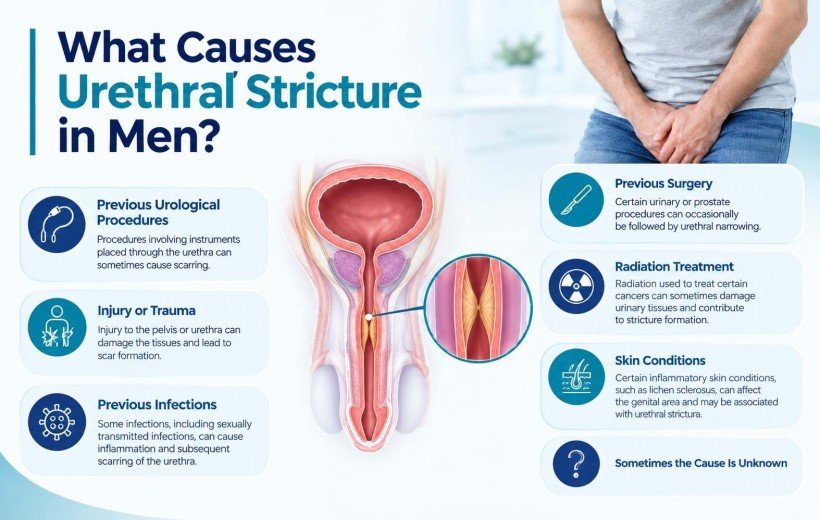
What Causes Urethral Stricture in Men?
Urethral stricture is generally caused by damage or inflammation that eventually produces scar tissue.
Some possible causes include:
Previous Urological Procedures
Procedures involving instruments placed through the urethra can sometimes cause scarring.
This may include certain endoscopic procedures or prolonged catheterization.
Injury or Trauma
Injury to the pelvis or urethra can damage the tissues and lead to scar formation.
This can occur following certain accidents or pelvic injuries.
Previous Infections
Some infections, including sexually transmitted infections, can cause inflammation and subsequent scarring of the urethra.
Previous Surgery
Certain urinary or prostate procedures can occasionally be followed by urethral narrowing.
Radiation Treatment
Radiation used to treat certain cancers can sometimes damage urinary tissues and contribute to stricture formation.
Skin Conditions
Certain inflammatory skin conditions, such as lichen sclerosus, can affect the genital area and may be associated with urethral stricture.
Sometimes the Cause Is Unknown
Even after evaluation, the exact cause is not always identified.
This is one reason why a detailed medical and surgical history is an important part of the diagnosis.
Urethral Stricture vs Enlarged Prostate: Are They the Same?
No.
Both conditions can cause difficulty passing urine, but they occur in different locations.
Benign prostatic hyperplasia (BPH) occurs when the prostate becomes enlarged and affects urine flow through the prostatic portion of the urethra.
A urethral stricture, on the other hand, is a narrowing of the urethra caused by scar tissue.
The symptoms can look similar, including:
- Weak urine flow
- Difficulty starting urination
- Incomplete bladder emptying
- Frequent urination
This means that simply treating urinary symptoms without determining the underlying cause may not solve the problem.
If you are experiencing persistent urinary symptoms, our Difficulty in Urine treatment service provides information about conditions that can interfere with normal urination.
How Is Urethral Stricture Diagnosed?
Diagnosing a urethral stricture usually involves combining your symptoms, medical history, physical examination, and appropriate investigations.
Your urologist may ask about:
- When the symptoms started
- Whether urine flow has gradually become weaker
- Previous catheterization
- Previous urinary procedures
- Pelvic or genital injuries
- Previous infections
- Previous prostate surgery
- Previous radiation treatment
- Episodes of urinary retention
Additional tests may then be recommended.
Urine Tests
Urine testing can help look for infection, blood, or other abnormalities.
If an infection is present, it may need to be treated as part of the overall management.
Uroflowmetry
A urine flow test measures how quickly urine passes through the urinary tract.
A reduced or abnormal flow may suggest an obstruction, although it does not by itself prove that a urethral stricture is present.
Post-Void Residual Measurement
This test measures how much urine remains in the bladder after urination.
A significant residual volume may indicate that the bladder is not emptying properly.
Retrograde Urethrogram
A retrograde urethrogram (RUG) uses X-ray imaging to examine the urethra.
It can help identify the location and length of a stricture and provide important information when planning treatment.
Cystoscopy
During cystoscopy, a thin instrument with a camera is used to examine the urethra and bladder.
It allows the urologist to directly inspect the urinary passage and identify narrowing or other abnormalities.
The exact combination of tests depends on the patient’s symptoms and clinical findings.
Why Early Diagnosis Matters
A urethral stricture should not be ignored simply because the urine is still passing.
As the narrowing becomes more significant, the bladder may have to work harder to push urine through the restricted passage.
Persistent obstruction can contribute to:
- Recurrent urinary infections
- Incomplete bladder emptying
- Urinary retention
- Bladder-related problems
- Worsening urinary symptoms
Inability to pass urine at all can require urgent medical attention.
If you suddenly cannot urinate, particularly when the bladder feels painfully full, seek prompt medical care rather than waiting for the problem to resolve on its own.
Urethral Stricture Treatment: What Are the Options?
There is no single treatment that is suitable for every urethral stricture.
Treatment depends on factors such as:
- Location of the stricture
- Length of the narrowed segment
- Severity
- Previous treatment
- Whether the stricture has returned
- Overall urinary function
- Individual patient factors
The main treatment approaches may include urethral dilation, endoscopic urethrotomy, or urethroplasty.
Urethral Dilatation
Dilatation involves gradually widening the narrowed portion of the urethra using specialized instruments.
It may be appropriate in selected situations, but recurrence can occur.
The decision should be made by a urologist after assessing the characteristics of the stricture.
Direct Vision Internal Urethrotomy
An endoscopic procedure may be used to open a suitable stricture from inside the urethra.
A small instrument is passed through the urethra to treat the scarred area.
This approach may offer a less invasive treatment option for selected strictures, but urethral strictures can recur after endoscopic treatment.
Urethroplasty
Urethroplasty is a reconstructive procedure used to repair or reconstruct the narrowed section of the urethra.
Depending on the type and location of the stricture, the surgeon may remove the scarred segment or reconstruct the urethra, sometimes using tissue grafts.
The appropriate approach depends on the individual stricture rather than simply choosing the least invasive procedure.
Can Urethral Stricture Come Back After Treatment?
Yes.
Recurrence is an important consideration in urethral stricture disease.
Some men may experience narrowing again after treatment, particularly depending on the location, length, cause, and previous treatment history.
For this reason, follow-up after treatment is important.
If urinary flow becomes weaker again after a procedure, do not assume it is simply a temporary change. Your urologist may need to reassess the urethra.
Can a Urethral Stricture Be Treated Without Surgery?
The answer depends on the individual case.
Some strictures can be managed with less invasive approaches, while others may require reconstructive surgery.
The important point is that treatment should be based on the characteristics of the stricture.
Simply taking medicines for weak urine flow will not remove scar tissue that is physically narrowing the urethra.
This is why accurate diagnosis is the first step.
When Should You See a Urologist?
You should consider a urological evaluation if you have:
- A persistently weak urine stream
- Difficulty starting urination
- Increasing difficulty passing urine
- Spraying or splitting of the urine stream
- Recurrent urinary infections
- A feeling that the bladder is not emptying
- Pain during urination
- Previous urethral injury
- Previous catheterization or urinary procedures
- Previous treatment for a urethral stricture
Men with persistent urinary symptoms should not automatically assume that an enlarged prostate is the cause.
A urethral stricture, infection, stone, bladder problem, neurological condition, or prostate condition may produce similar symptoms.
When Is Difficulty Passing Urine an Emergency?
Seek urgent medical attention if you become completely unable to pass urine.
Acute urinary retention can cause significant discomfort and may require immediate bladder drainage.
You should also seek prompt medical attention if difficulty urinating is accompanied by:
- Severe lower abdominal pain
- Fever or chills
- Vomiting
- Significant blood in the urine
- Severe weakness or illness
Do not wait several days to see whether complete urinary obstruction resolves on its own.
For more information, see our page on Difficulty in Urine.
Urethral Stricture Treatment in Dhanbad
If you are looking for urethral stricture treatment in Dhanbad, the first step is an accurate diagnosis.
Dr. Saket Narnoli provides urological care in Dhanbad and has a clinical focus that includes endourology and urinary tract conditions. His Endourology service covers procedures used to inspect and treat problems involving the urinary tract, including urethral blockages.
Depending on the patient’s symptoms and diagnosis, a urologist can determine whether further investigation or an appropriate procedure is required.
You can learn more about Endourology treatment in Dhanbad and the different minimally invasive procedures used to evaluate urinary tract conditions.
Why Choose a Urologist for Urethral Stricture?
Urethral stricture can look like several other urinary conditions.
A specialist evaluation can help determine:
- Whether a stricture is actually present
- Where the narrowing is located
- How extensive it is
- Whether there is associated infection or obstruction
- Which treatment is appropriate
- Whether follow-up is required after treatment
Dr. Saket Narnoli’s practice includes urology, endourology, and other areas of specialized urological care in Dhanbad.
You can also learn more about Dr. Saket Narnoli, his treatment philosophy, qualifications, and areas of urological practice.
Contact us to book a semen analysis and consultation at our Dhanbad clinic, and get a clear picture of where things stand.
Book Your Appointment with Dr. Saket Narnoli Today!
Consult Dr. Saket Narnoli, leading Uro-Oncologist and Laparoscopic Urologist in Dhanbad, for kidney, bladder, prostate, and urinary tract conditions. Call today to schedule your visit.
Frequently Asked Questions About Urethral Stricture
What is the main symptom of urethral stricture?
A weak or reduced urine stream is one of the common symptoms. Other symptoms can include difficulty starting urination, spraying of urine, incomplete bladder emptying, painful urination, and recurrent urinary infections.
Can a urethral stricture cause urinary retention?
Yes. A severe narrowing can significantly restrict urine flow and, in some cases, contribute to urinary retention.
If you cannot pass urine at all, seek urgent medical attention.
Is urethral stricture caused by an infection?
An infection can be one possible cause, but strictures can also develop after trauma, catheterization, instrumentation, surgery, radiation, or inflammatory conditions. In some cases, the cause remains unknown.
Is urethral stricture the same as an enlarged prostate?
No. Both can cause similar urinary symptoms, but a urethral stricture involves narrowing of the urethra due to scar tissue, while BPH involves enlargement of the prostate.
Can medicines cure urethral stricture?
Medicines may help manage associated problems such as infection, but they generally do not remove established scar tissue causing a physical narrowing. Depending on the stricture, procedures such as dilation, endoscopic treatment, or urethroplasty may be considered.
Can urethral stricture return after treatment?
Yes. Recurrence can occur, so follow-up is important after treatment.
Which doctor treats urethral stricture?
A urologist evaluates and treats urethral stricture disease. The appropriate treatment depends on the location, length, severity, cause, and previous treatment history.
This article is intended for general educational purposes and does not replace an in-person medical consultation. Urethral stricture can have different causes and degrees of severity. Diagnosis and treatment should be decided by a qualified urologist after reviewing your symptoms, medical history, examination, and appropriate investigations.