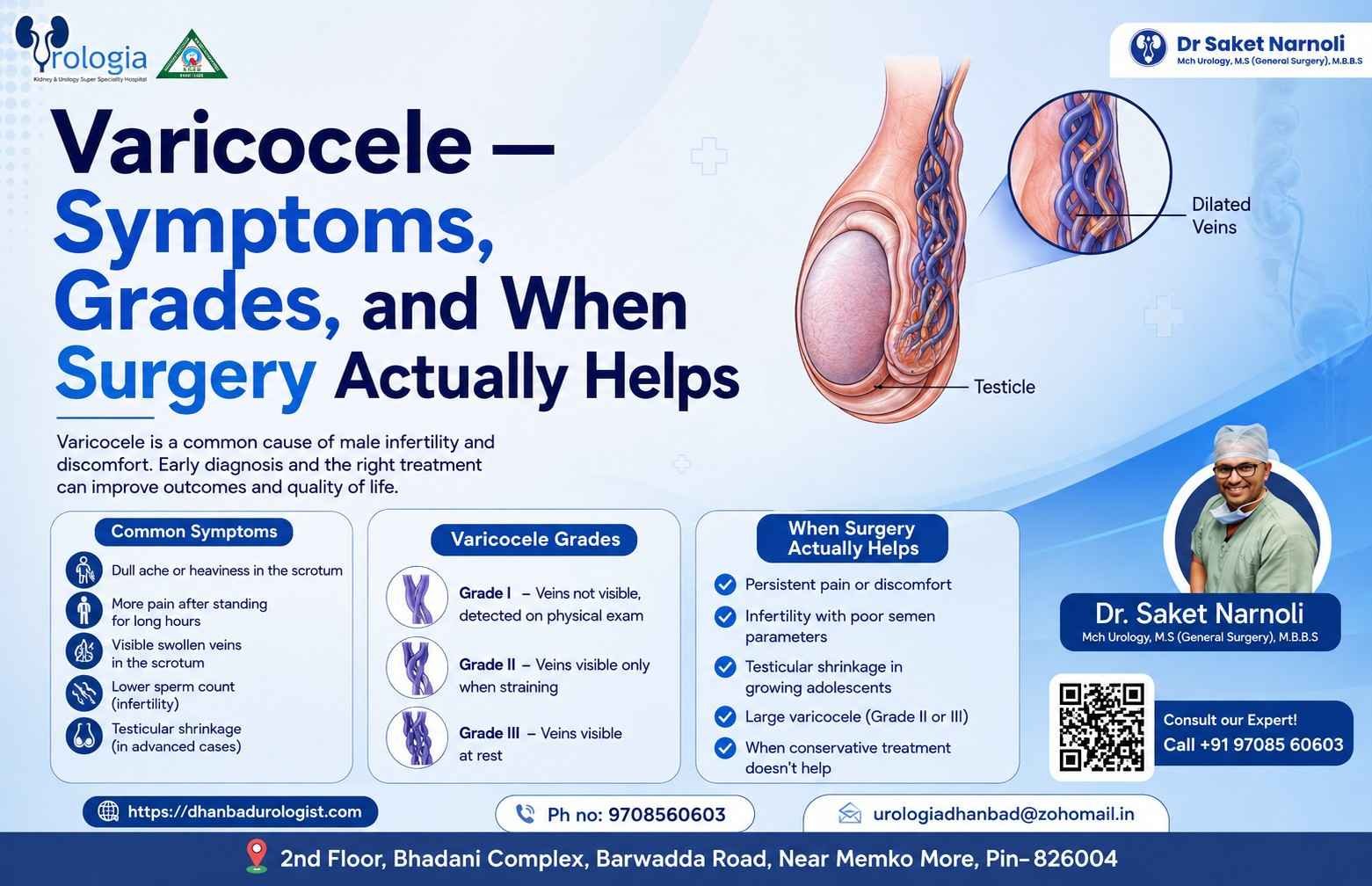
A dull, dragging ache in the scrotum, worse by evening or after standing all day — that’s the most common way a varicocele shows up. Some men feel nothing at all and only find out during a fertility workup. Either way, the question we hear most often is the same: does this actually need surgery, or can I leave it alone?
The honest answer is: it depends on the grade, the symptoms, and whether you’re trying to conceive. We explain that clearly below, along with what treatment actually involves if you do need it.
What Is a Varicocele?
A varicocele is an enlarged vein inside the scrotum, similar to a varicose vein in the leg. It happens when the valves inside the veins draining the testicle don’t close properly, letting blood pool instead of flowing back up normally. This is more common on the left side because of how the left testicular vein connects higher up, giving gravity more pull.
Varicoceles are common — they show up in about 15% of adult men and are one of the most frequent findings in men evaluated for male infertility symptoms. Most cause no problems at all. A smaller number cause pain, visible swelling, or reduced fertility, and that’s where treatment becomes worth discussing.
The Grading System, in Plain Terms
Doctors grade varicoceles by how easily they can be felt or seen. This matters because grade influences whether treatment is even necessary.
- Grade 1 (small): Only felt during a specific maneuver called the Valsalva (bearing down, like straining) — not felt otherwise
- Grade 2 (moderate): Felt easily on standing exam without needing to strain
- Grade 3 (large): Visible through the skin, looks like a bag of worms or “spaghetti” under the scrotal skin
A higher grade doesn’t automatically mean you need surgery. A Grade 3 varicocele that causes no pain and isn’t affecting fertility may still be left alone. A Grade 1 varicocele causing significant pain, on the other hand, might warrant treatment. Symptoms and impact matter more than the number itself.
What Causes a Varicocele?
The exact trigger isn’t always clear, but the mechanics are well understood:
Faulty vein valves. The valves inside the spermatic veins are supposed to stop blood from flowing backward. When they don’t close fully, blood pools and the vein stretches over time.
Anatomy of the left testicular vein. It joins the kidney vein at an angle that gets less help from gravity than the right side, which is why roughly 90% of varicoceles occur on the left.
Prolonged standing or heavy lifting. These don’t cause a varicocele outright but can worsen symptoms in someone who already has one, since gravity and increased pressure add to the pooling.
Symptoms Worth Paying Attention To
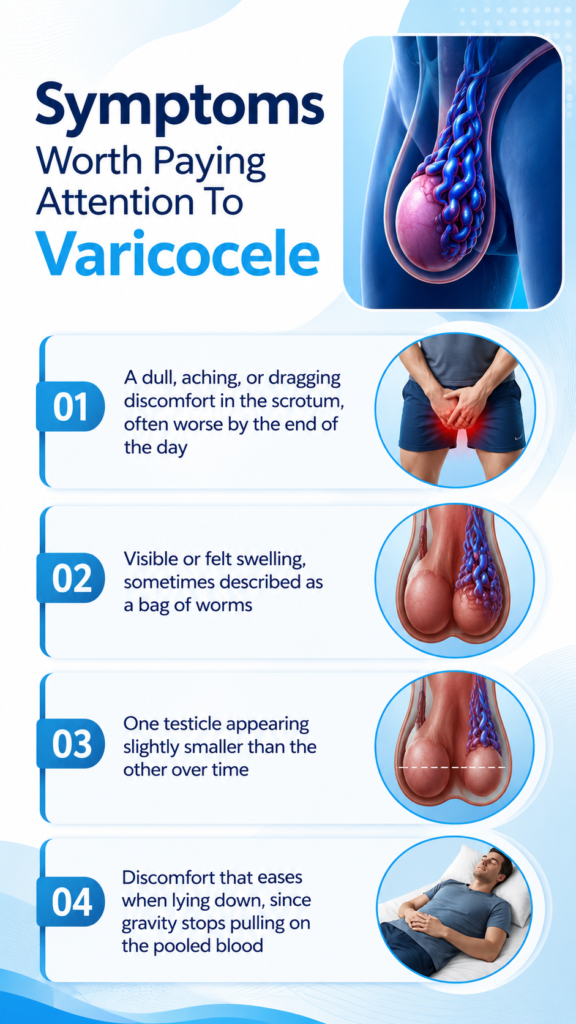
Many men have no symptoms at all. When symptoms do appear, they typically include:
- A dull, aching, or dragging discomfort in the scrotum, often worse by the end of the day
- Visible or felt swelling, sometimes described as a bag of worms
- One testicle appearing slightly smaller than the other over time
- Discomfort that eases when lying down, since gravity stops pulling on the pooled blood
If you notice sudden, sharp pain rather than a dull ache, or swelling that appears overnight, that’s less typical of a varicocele and should be checked promptly — it could point to a different, more urgent problem like testicular torsion.
How We Diagnose It
Diagnosis usually starts with a straightforward physical exam. We check for the bag-of-worms feel with you standing, then ask you to strain (the Valsalva maneuver) to check for a Grade 1 varicocele that isn’t otherwise felt.
If fertility is a concern, or if the exam is unclear, we typically add:
- Scrotal ultrasound with Doppler, which confirms the diagnosis and measures the exact size and blood flow pattern
- Semen analysis, if you’re trying to conceive, to check whether the varicocele is affecting sperm count or movement
- Hormone tests, in select cases, if testicular size or function appears affected
When Does a Varicocele Actually Need Treatment?
This is the part most articles gloss over, so we’ll be direct about it.
Treatment is usually recommended when:
- The varicocele causes ongoing pain that affects daily activity
- You’re trying to conceive and semen analysis shows abnormal results
- The affected testicle is visibly smaller or not growing normally (particularly relevant in teenagers)
Treatment is usually not necessary when:
- The varicocele is asymptomatic and semen parameters are normal
- Fertility isn’t a current concern
- Discomfort is mild and manageable with supportive underwear or over-the-counter pain relief
If you fall into the second group, we won’t push you toward surgery just because a varicocele is visible on exam. Watchful waiting with periodic follow-up is a legitimate, medically sound choice.
Treatment Options: What Varicocelectomy Actually Involves
When treatment is warranted, the standard procedure is a varicocelectomy — surgically tying off the affected veins to stop the backward blood flow, while preserving the artery and lymphatic vessels that the testicle needs.
There are a few approaches:
Microsurgical varicocelectomy. Performed through a small incision using an operating microscope to identify and spare the artery precisely. This has the lowest recurrence rate among the surgical options.
Laparoscopic varicocelectomy. Done through small keyhole incisions in the abdomen. Recovery is generally quicker than open surgery, with a similar success rate.
Embolization. A non-surgical, catheter-based option performed by an interventional radiologist, blocking the vein from the inside rather than tying it off. It’s less invasive but has a somewhat higher recurrence rate than microsurgical repair.
We’ll walk you through which approach fits your specific case — grade, anatomy, and whether fertility is the primary concern all factor into that decision.
What to Expect: Recovery
Most varicocelectomy procedures are done as day-care surgery or with a single night’s stay. You can expect:
- Mild swelling and discomfort for 3 to 5 days, managed with pain medication
- A return to desk work within about a week
- Avoiding heavy lifting or strenuous exercise for 4 weeks
- A follow-up semen analysis around 3 months later, since that’s how long it takes for newly produced sperm to reflect any improvement
We won’t promise a guaranteed pregnancy outcome — that depends on your partner’s fertility factors too. What surgery can reliably do is improve semen parameters in a majority of men with abnormal counts linked to the varicocele, and relieve pain in most men treated for that reason.
Honest Limitations
Varicocele repair isn’t right for everyone, and it isn’t a guaranteed fix even when it is right for you.
- Recurrence happens in a small percentage of cases regardless of technique
- If sperm count is extremely low or absent for reasons unrelated to the varicocele, repair alone won’t resolve infertility
- Surgery carries the same general risks as any procedure — infection, fluid collection (hydrocele), or, rarely, injury to the surrounding artery
If your case needs a combined approach — for instance, varicocele repair alongside broader male infertility treatment — Dr. Saket Narnoli will lay out that full plan rather than treating the varicocele in isolation.
A Straightforward Next Step
If you’ve noticed scrotal discomfort, swelling, or were told during a check-up that you have a varicocele, an evaluation gives you a clear answer instead of ongoing uncertainty. Many men we see as a trusted urologist in Dhanbad come in expecting the worst and leave with a simple watch-and-wait plan — treatment is only one of several possible outcomes.
Contact us to schedule an evaluation, or if you’d rather ask a quick question first, WhatsApp us directly. For more on how varicoceles connect to broader fertility concerns, our earlier guide on male infertility treatment in Dhanbad covers the full picture.
Contact us to book a semen analysis and consultation at our Dhanbad clinic, and get a clear picture of where things stand.
Book Your Appointment with Dr. Saket Narnoli Today!
Consult Dr. Saket Narnoli, leading Uro-Oncologist and Laparoscopic Urologist in Dhanbad, for kidney, bladder, prostate, and urinary tract conditions. Call today to schedule your visit.
Frequently Asked Questions
Q: Can a varicocele go away on its own?
A: No, a varicocele doesn’t resolve on its own once it’s formed. It can, however, stay stable for years without causing problems, which is why not every varicocele needs treatment.
Q: Does having a varicocele mean I’m infertile?
A: No. Many men with a varicocele have completely normal fertility. It’s one possible contributing factor among several, not a diagnosis of infertility by itself.
Q: Is varicocele surgery painful?
A: Most men describe post-surgery discomfort as manageable with standard pain medication, similar to a mild pulling sensation rather than sharp pain. It typically settles within the first week.
Q: Will my varicocele come back after surgery?
A: Recurrence is uncommon, particularly with microsurgical repair, but it isn’t impossible. Periodic follow-up after surgery helps catch it early if it does happen.
Q: I don’t have pain — should I still get it checked?
A: If you noticed it yourself or a doctor mentioned it during an exam, it’s worth a one-time evaluation with an ultrasound, even without pain, especially if you’re planning to have children.
Medical Disclaimer: This article is for informational purposes only and does not constitute medical advice. Please consult a qualified urologist for diagnosis and treatment tailored to your specific condition.