Dr. Saket Narnoli, Consultant Urologist, Andrologist and Uro-Oncologist, M.Ch (Urology), BJ Medical College, Ahmedabad
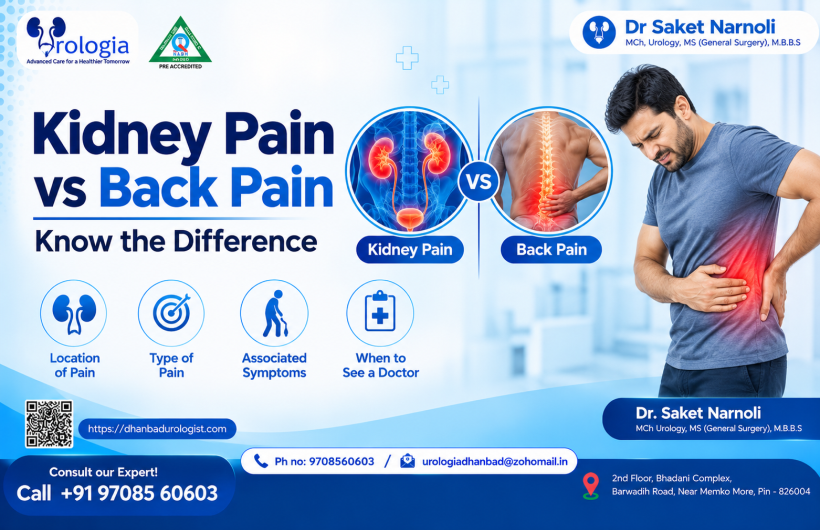
Kidney pain is usually felt higher up and deeper than muscle-related back pain. It sits on one side, just below the ribs, and does not change when you move or change position. Back pain is more often in the lower back, gets worse with bending or lifting, and eases with rest.
The difference matters because treating kidney pain as a muscle strain can delay care for a stone or infection. If you are stuck on kidney pain vs back pain, you are not alone, since the two feel very similar at first. As a urologist in Dhanbad, we often meet patients who tried balms, massage or painkillers for weeks before getting a scan.
Where Are Your Kidneys, and Why Does Kidney Pain Feel Like Back Pain?
Many people think of the kidneys as sitting in the lower back, but they are higher than that. They lie on either side of the spine, tucked behind the lower ribs.
Because they sit so close to the back muscles, kidney problems are often felt as “back pain.” This is why patients describe a kidney stone as a stubborn backache that does not respond to rest.
What Does Kidney Pain Feel Like?
Kidney pain is usually felt in the flank, which is the area between your lowest rib and your hip. It generally affects one side, though both kidneys can be involved.
It may be a constant, deep ache, or it may come in waves of severe, sharp pain when a stone moves down the urinary tract. The pain can travel toward the lower abdomen or groin.
The key clue is that it does not get better when you change position. Patients often say they tried lying down, sitting up and stretching, and nothing helped.
What Does Back Pain Usually Feel Like?
Muscle or spine-related back pain tends to sit in the lower back, in the centre or on both sides. It often starts after lifting something heavy, sitting for hours, or sleeping in an awkward position.
It usually gets worse when you bend, twist or stand up, and it often eases with rest or a change of position. Pressing on the sore spot is often tender. A pinched nerve may also send pain or tingling down the leg.
Kidney Pain vs Back Pain: A Side-by-Side Comparison
| Feature | Kidney Pain | Back (Muscle or Spine) Pain |
|---|---|---|
| Location | One side, below the ribs, may reach the groin | Lower back, centre or both sides, may reach the buttock or leg |
| Type of Pain | Deep dull ache, or waves of sharp pain | Stiff, achy, or sharp with movement |
| Effect of Movement | Little or no change with position | Worse with bending or lifting, better with rest |
| Other Symptoms | Fever, nausea, burning urine, blood in urine | Muscle tightness, tenderness, leg tingling |
| Start | Sudden (stone) or over a day or two (infection) | After lifting or poor posture, or gradual |
Keep in mind that this table is a guide, not a diagnosis. Some patients have symptoms from both columns.
What Causes Kidney Pain?
The most common causes of kidney-related pain are:
- Kidney stones: A stone can block the flow of urine and cause severe pain. Our guide on blood in urine explains why a stone often shows up as pink or red urine.
- Kidney infection: Bacteria travelling up from the bladder cause pain with fever and chills. Our urinary tract infection guide covers how this starts.
- Urine blockage (hydronephrosis): Swelling of the kidney from a blocked ureter or other obstruction.
- Kidney cysts or injury: Less common, but they can cause a dull ache or tenderness.
Which Symptoms Point Toward the Kidney?
If your back or flank pain comes with any of the following, the kidney or urinary tract is more likely to be involved:
- Blood in the urine, or urine that is dark, cloudy or foul-smelling
- Burning or pain while passing urine
- A frequent urge to urinate
- Fever, chills or shivering
- Nausea or vomiting
- Pain that comes in waves and spreads to the groin
When Should You See a Doctor Right Away?
Go to a hospital the same day if you have kidney-type pain with fever, repeated vomiting, or if you cannot pass urine. A blocked, infected kidney can become dangerous quickly.
Also seek urgent care if the pain is so severe that you cannot sit still, or if you have blood in your urine. People with only one working kidney should not wait.
Seek emergency help for back pain if you notice new weakness in the legs, numbness in the groin area, or loss of control over urine or stool. This points to a nerve problem rather than the kidney.
How Does a Urologist Tell the Difference?
The first step is a conversation about where the pain is, what makes it better or worse, and any urinary symptoms. Dr. Saket Narnoli then examines the area and usually requests a urine test, blood tests, and an ultrasound or a CT scan, depending on the case.
These tests quickly show whether a stone, infection or blockage is present. If the kidney tests are normal, we can say so confidently and advise you to see an orthopedic or physiotherapy specialist for your back.
Treatment depends on the cause. Small stones may pass with fluids and monitoring, while larger or blocked stones may need a procedure. Infections are treated with the right antibiotics.
Why Painkillers Alone Are Not the Answer
Painkillers can hide the symptoms of a stone or infection while the problem keeps getting worse. Taking painkillers such as diclofenac or ibuprofen for long periods can also harm the kidneys, especially if you are dehydrated.
In Dhanbad’s hot summers, many people drink less water without realising it. Dehydration makes both stone formation and kidney strain more likely.
Don’t Guess: Get Your Pain Checked
Back pain that does not improve after a few days of rest, or any pain that comes with fever or urinary changes, deserves a proper check. A urine test and an ultrasound can usually settle the question within a day.
You can book an appointment at our clinic in Bhadani Complex, Barwadda Road, Dhanbad. If you would like to describe your symptoms first, you can also chat with us on WhatsApp.
Book Your Appointment with Dr. Saket Narnoli Today!
Consult Dr. Saket Narnoli, leading Uro-Oncologist and Laparoscopic Urologist in Dhanbad, for kidney, bladder, prostate, and urinary tract conditions. Call today to schedule your visit.
Frequently Asked Questions
Can kidney pain feel like back pain?
Yes. The kidneys sit behind the lower ribs near the spine, so kidney problems are often felt as pain in the back or side.
Which side does kidney pain occur on?
Usually the side of the affected kidney, though some conditions affect both. Pain on one side with urinary symptoms is a strong reason to get checked.
Does kidney pain get worse when you move?
Generally not. If the pain clearly changes with movement or posture, a muscle or spine cause is more likely.
Can drinking water relieve kidney pain?
Drinking enough water helps prevent stones and infections, but it does not treat severe pain, fever or a blocked kidney. If the pain is strong or does not settle, please see a doctor.
Which doctor should I see for kidney pain?
A urologist is the right doctor for stones, infections and urinary blockages. A physician or orthopedic doctor may be needed if tests show the kidney is normal.
This article is for general information only and is not a substitute for medical advice. Please consult a qualified doctor about your own symptoms.