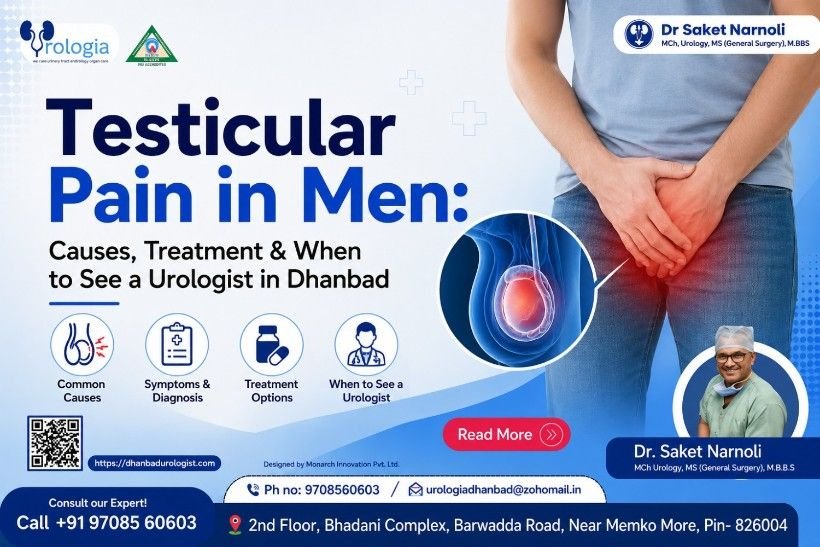
Testicular pain in men can range from a mild, temporary discomfort to a medical emergency. Pain may occur in one testicle, both testicles, the scrotum, groin or even the lower abdomen.
The important point is that the severity of pain does not always tell you how serious the underlying problem is. Sudden, severe testicular pain, particularly when associated with swelling, nausea or vomiting, can be a sign of testicular torsion and needs urgent medical assessment.
Other causes include infections, injuries, varicocele, hydrocele, hernia, kidney stones and inflammation of structures around the testicle.
As a urologist, I advise men not to ignore persistent or unexplained testicular pain simply because the discomfort is manageable.
Quick Answer: What Causes Testicular Pain in Men?
Common causes of testicular or scrotal pain include:
- Testicular torsion
- Epididymitis or other infections
- Injury or trauma
- Varicocele
- Hydrocele
- Inguinal hernia
- Kidney stones
- Prostatitis
- Urinary tract infections
- Testicular or scrotal masses
- Nerve-related or referred pain
Sometimes the pain originates outside the testicle. For example, a kidney stone can cause pain that travels toward the groin or testicle.
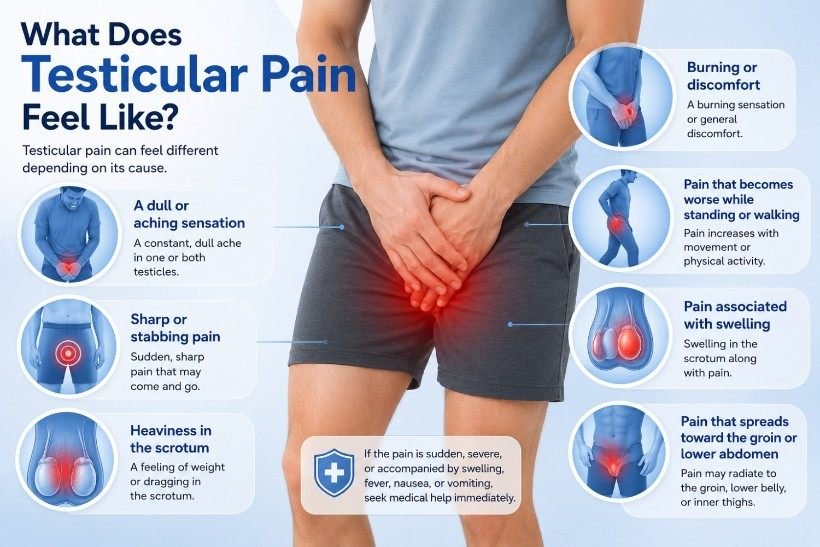
What Does Testicular Pain Feel Like?
Testicular pain can feel different depending on its cause.
You may experience:
- A dull or aching sensation
- Sharp or stabbing pain
- Heaviness in the scrotum
- Burning or discomfort
- Pain that becomes worse while standing or walking
- Pain associated with swelling
- Pain that spreads toward the groin or lower abdomen
Some conditions cause gradual discomfort, while others can develop suddenly.
This is why an examination by a qualified urologist is often more useful than trying to identify the cause from symptoms alone.
7 Common Causes of Testicular Pain
1. Testicular Torsion
Testicular torsion is one of the most important causes to recognise because it can cut off the blood supply to the testicle.
Typical warning signs include:
- Sudden, severe testicular pain
- Rapid swelling of the scrotum
- Nausea or vomiting
- Lower abdominal pain
- A testicle sitting higher than usual
- Pain that develops suddenly, sometimes during sleep
Sudden severe testicular pain should be treated as an emergency.
Prompt treatment is important because prolonged loss of blood supply can permanently damage the testicle.
2. Epididymitis or Infection
The epididymis is a small tube located behind the testicle that stores and transports sperm.
Inflammation or infection of the epididymis can cause:
- Gradually increasing scrotal pain
- Swelling
- Tenderness
- Burning while urinating
- Frequent urination
- Fever in some cases
A urinary or genital infection may sometimes be responsible.
If you are also experiencing burning, urgency or frequent urination, you can read our detailed guide on urinary tract infections and their symptoms for additional information.
3. Varicocele
A varicocele occurs when veins around the testicle become enlarged.
It commonly causes a dull, dragging or heavy sensation, which may become more noticeable after prolonged standing or toward the end of the day.
Not every varicocele requires treatment. Management depends on symptoms, examination findings and whether there is an associated fertility problem.
For men experiencing fertility concerns along with a varicocele, a proper evaluation may include a physical examination, scrotal Doppler ultrasound and semen analysis.
You can also learn more about male infertility and its treatment options before deciding on your next step.
4. Injury or Trauma
A direct blow to the groin can cause testicular pain and swelling.
Even when an injury appears minor, persistent pain, significant swelling or changes in the testicle should not be ignored.
A urologist may recommend an examination and, when appropriate, scrotal ultrasound to rule out internal injury or another underlying problem.
5. Kidney Stones
Not all testicular pain actually starts in the testicle.
A kidney stone can produce pain in the side or back that travels toward the lower abdomen, groin or testicle.
This is known as referred pain.
If your testicular discomfort is accompanied by severe flank pain, nausea, vomiting or blood in the urine, a urinary-system cause such as a kidney stone should also be considered.
Our guide to kidney stone symptoms and treatment explains when stone-related pain requires medical attention.
6. Inguinal Hernia
An inguinal hernia develops when tissue pushes through a weak area in the abdominal wall.
It can cause:
- Groin discomfort
- A visible or palpable bulge
- Pain while lifting or straining
- Discomfort extending into the scrotum
Because several conditions can produce similar symptoms, a proper examination is important before assuming that the pain is caused by a testicular problem.
7. Hydrocele or Other Scrotal Conditions
A hydrocele occurs when fluid collects around the testicle and may cause swelling or a feeling of heaviness.
Other scrotal conditions can also produce swelling, tenderness or a lump.
A new lump should be examined even if it is painless. Some scrotal masses require further investigation to determine their cause.
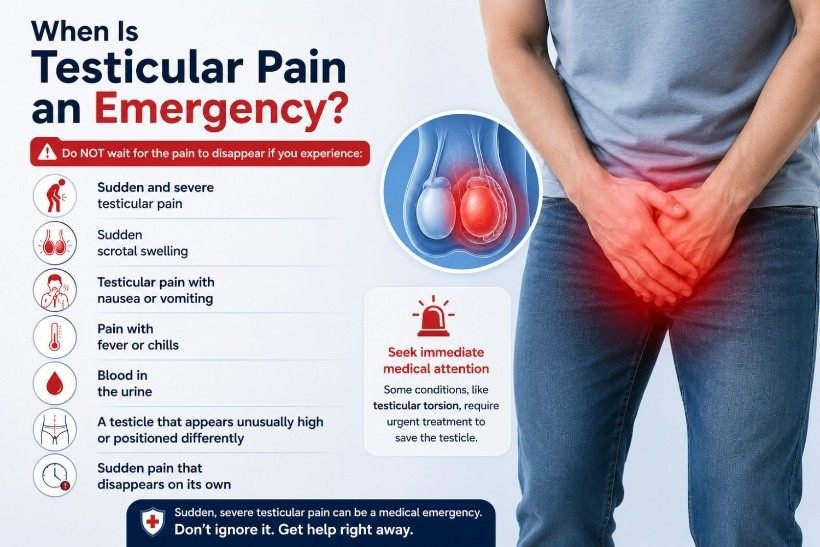
When Is Testicular Pain an Emergency?
Do not wait for the pain to disappear if you experience:
- Sudden and severe testicular pain
- Sudden scrotal swelling
- Testicular pain with nausea or vomiting
- Pain with fever or chills
- Blood in the urine
- A testicle that appears unusually high or positioned differently
- Sudden pain that disappears on its own
Sudden pain that improves does not necessarily mean the problem has resolved. Intermittent twisting and untwisting of the testicle can also occur and requires medical assessment.
When Should You See a Urologist?
Make an appointment if:
- Mild testicular pain continues for more than a few days
- Pain repeatedly comes and goes
- You notice a lump or swelling
- One testicle appears different in size
- You have unexplained scrotal heaviness
- You have pain along with urinary symptoms
- You are experiencing fertility problems
A specialist can determine whether the pain is coming from the testicle, epididymis, urinary tract, prostate, kidney or another nearby structure.
How Is Testicular Pain Diagnosed?
There is no single test for every case of testicular pain.
A urologist may begin with:
Medical history
You may be asked:
- When did the pain begin?
- Did it start suddenly or gradually?
- Is it on one side or both?
- Does it worsen with activity or standing?
- Have you had an injury?
- Do you have fever or urinary symptoms?
- Have you noticed swelling or a lump?
- Are you experiencing fertility problems?
Physical examination
The doctor examines the abdomen, groin, scrotum and testicles to identify tenderness, swelling, masses or other abnormalities.
Scrotal ultrasound
A scrotal ultrasound, sometimes combined with Doppler imaging, may be used when the diagnosis is uncertain or when there is swelling, a lump or concern about blood flow.
The exact investigation depends on the symptoms and examination findings.
What Is the Treatment for Testicular Pain?
There is no universal treatment because testicular pain is a symptom rather than a single disease.
Treatment depends on the underlying cause.
If the cause is an infection
Appropriate medication may be prescribed after clinical evaluation and testing where necessary.
If the cause is varicocele
Some men require only observation and symptom management. Treatment may be considered when there is persistent pain, fertility-related concern or testicular growth problems.
If the cause is a kidney stone
Treatment depends on the stone’s size, location, symptoms and whether it is causing obstruction or complications.
If the cause is testicular torsion
Emergency treatment is required to restore blood flow and protect the testicle.
If the cause is a hernia or another structural problem
Treatment is determined according to the underlying condition and its severity.
This is why taking painkillers without finding the cause is not an appropriate long-term solution for unexplained or recurrent testicular pain.
Can Testicular Pain Be Prevented?
Not every cause can be prevented, but some general measures can reduce avoidable problems:
- Wear appropriate protective equipment during contact sports.
- Practise safer sexual habits.
- Maintain good urinary and genital hygiene.
- Drink adequate fluids.
- Do not ignore recurrent urinary symptoms.
- Seek medical attention after significant testicular injury.
- Pay attention to new lumps or changes in the testicles.
- Seek prompt care for sudden severe pain.
Men with recurring urinary, sexual or reproductive symptoms may benefit from a broader urological evaluation.
Testicular Pain and Male Fertility
Some conditions associated with testicular discomfort can also affect fertility.
For example, varicocele may be associated with reduced sperm production or abnormal sperm parameters in some men, although not every man with a varicocele develops infertility.
If you have testicular discomfort together with difficulty conceiving, a urologist or andrologist can assess both problems rather than treating the pain in isolation.
Why You Should Not Self-Diagnose Testicular Pain
Searching online can help you understand possible causes, but it cannot determine whether your symptoms are due to torsion, infection, varicocele, kidney stones, hernia or another condition.
This distinction matters because the urgency and treatment are completely different.
For example, mild aching that develops gradually may have a very different cause from sudden severe pain with swelling.
When the pain is sudden or severe, seek urgent medical care rather than waiting for home remedies to work.
Testicular Pain Treatment in Dhanbad
If you are looking for a urologist in Dhanbad for testicular pain, swelling or other male reproductive concerns, evaluation should focus on identifying the underlying cause rather than simply controlling the pain.
Dr. Saket Narnoli is a consultant urologist, andrologist and uro-oncology specialist in Dhanbad. He has completed M.Ch. in Urology from BJ Medical College, Ahmedabad, along with MBBS and MS training, and has experience in urological surgery and advanced urology.
His practice includes evaluation and treatment of urinary and male reproductive conditions, with services covering andrology, male infertility, endourology and laparoscopic urology.
If you have persistent testicular pain, a new swelling or a lump, professional assessment can help identify the problem early.
Contact us to book a semen analysis and consultation at our Dhanbad clinic, and get a clear picture of where things stand.
Book Your Appointment with Dr. Saket Narnoli Today!
Consult Dr. Saket Narnoli, leading Uro-Oncologist and Laparoscopic Urologist in Dhanbad, for kidney, bladder, prostate, and urinary tract conditions. Call today to schedule your visit.
Frequently Asked Questions
Is testicular pain always serious?
No. Testicular pain can have relatively minor causes, but some conditions are emergencies. Sudden severe pain should always be assessed urgently because testicular torsion is one possible cause.
Can kidney stones cause testicular pain?
Yes. Pain from a kidney stone can travel from the side or back toward the groin and testicle. This is called referred pain.
Can varicocele cause testicular pain?
Yes. Varicocele can cause a dull or dragging discomfort, often more noticeable after standing for a long time or later in the day.
Should I see a doctor for a painless testicular lump?
Yes. A new testicular or scrotal lump should be evaluated even when it does not hurt.
What test is used to diagnose testicular pain?
Depending on the symptoms, the evaluation may include physical examination, urine testing and scrotal ultrasound with Doppler. The appropriate tests depend on the suspected cause.
Can testicular pain affect fertility?
The pain itself does not necessarily cause infertility, but some underlying conditions associated with testicular pain—such as varicocele—can affect sperm production or fertility in some men.
Final Takeaway
Testicular pain in men should not be automatically dismissed as a minor problem.
The cause may be an infection, injury, varicocele, kidney stone, hernia or another condition. However, sudden severe testicular pain is an emergency until a serious cause such as testicular torsion has been ruled out.
If the pain is persistent, recurrent, associated with swelling or accompanied by urinary or fertility problems, consult a urologist for a proper evaluation.
Medical Disclaimer: This article is for general educational purposes and does not replace an in-person medical consultation. Testicular pain can have different causes, and diagnosis requires assessment by a qualified healthcare professional.